Do you use generative AI on a regular basis?
I use it in my daily work, not only in the professional field of code generation and architecture planning, but also for drawing pictures and illustrations on Nano Banana, and also to support the creation of blog posts on this site. It would not be an exaggeration to say that I use it every day.
And recently, I started using it in the field of running. I would like to share my experience with the use of generative AI (Gemini, ChatGPT, etc.) in my daily training, because I found it amazingly useful as well as interesting or something. It’s as if I have a virtual personal trainer by my side all the time, giving me feedback on form improvement and questions I have.
My Shoe History and Form Changes
For many years, I was a fan of Zero Drop andMinimalist shoes. These shoes, which promote a natural landing, allow me to run with a good use of my foot muscles. But around 2020-2023, when I was an ambassador for Decathlon (Decathlon), I was mainly wearing shoes with more cushioning, if anything. Decathlon shoes are very cost-effective, but there were no zero-drop models, and most of them were closer to high cushioning.
When I went back to Altra and Topo Athletic zero-drop shoes again after my ambassador period ended, I had no problems with daily jogging, but I began to experience calf pain and discomfort during races and long distance runs.
I do not believe the cause is that my stride (stride length) has become longer and overstriding after several years of high cushion shoes. This has been shown to be the case by analyzing the metrics we are getting on our smartwatches.
It appears that the load on the calf and Achilles tendon changed as a result of over-reliance on shock absorption during landing. When they return to zero drop, the calves are suddenly in a state of being stretched, and it is common for them to experience pain.
Insights and remedies gained from consulting a generative AI
Utilizing Generative AI. After daily post-run feedback (“It was a 20 km trail race, but my calf got tight,” “What’s the form without kicking?” etc.) into the AI and get feedback.
For example:
- Distance run, pace, type of shoes
- Any discomfort you felt (calf pain, landing position, etc.)
- Historical data (Garmin or Strava logs shared via text)
- Questions about things you were curious about, etc.
When you pour this into Gemini, you get back advice based on scientific evidence. ‘Why don’t you try increasing your pitch to around 180 SPM (steps per minute)? I was convinced when he pointed out that “it could be the effect of a high cushion habit that tends to lengthen the stride”.
180 SPM is the efficient pitch that many elite runners use as a benchmark, and it is said to shorten ground contact time and distribute the burden. I used the metronome function on my smartwatch to be aware of the pitch.
Furthermore, I discussed with him what drills and workouts I should do to improve my form, and he suggested the following
| Drill name | Effect |
|---|---|
| Ankle hop | Strengthen ankle spring and increase resilience |
| One-handed ups (100 ups) | Standard drill to set the rhythm for landing and knee lifts |
| Single Leg Deadlift | Strengthens hamstrings and stability |
| Eccentric Calf Raise | Strengthens endurance by training the lowering contraction of the calf |
| Pull-up drills with the wall | The strongest drill to develop a “just pull up” feel. Creates a situation where you can’t kick the ground. |
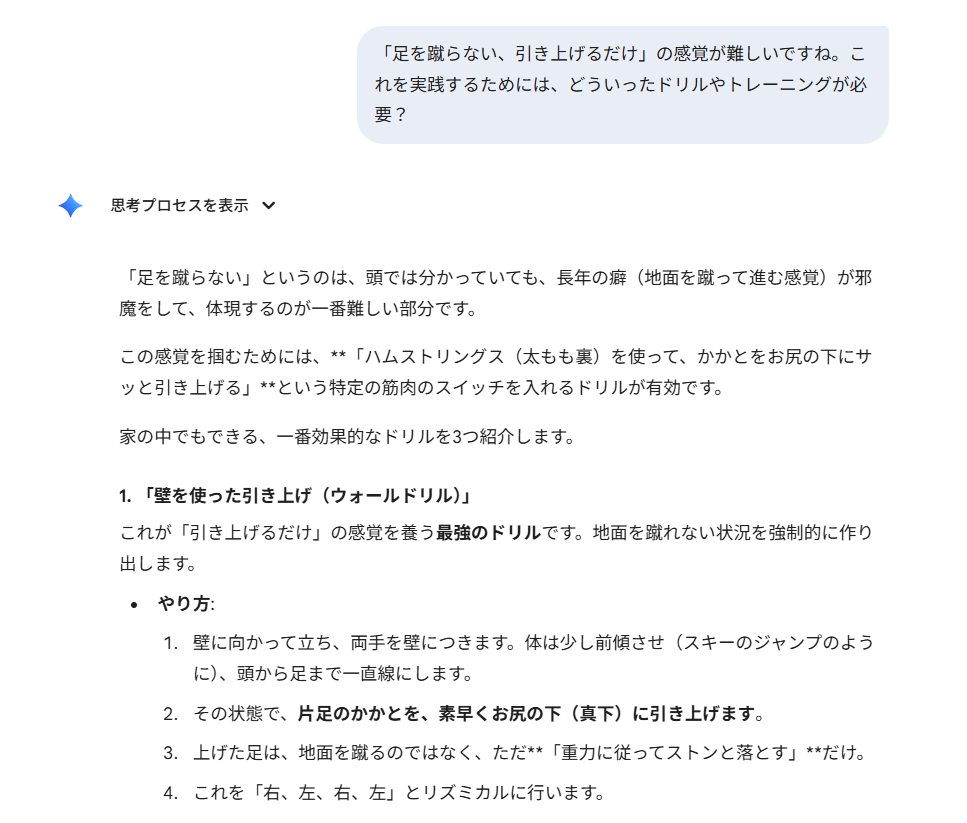
I am still in the beginning stages of doing this, so I don’t feel much improvement, but what I feel most now is that I am getting the most out of my zero-drop shoes by switching to a pitch running style.
At first, I was thinking of replacing them with low drop shoes (3mm-6mm), but I thought the foot pain was some kind of omen, so I asked the generating AI casually and it has been about 2 weeks since then.
Why I would recommend it to everyone.
Generation AI can be consulted 24/7 and accumulates personal data to give you more accurate advice.
- Share daily logs → analyze like a trainer
- Monthly review → summarizes your progress
- Suggest new drills and stretches → It even gives you video links
Of course, AI is not a replacement for a doctor or a real trainer, but it is very useful as a virtual coach.
You should also try throwing your thoughts to the AI after your run. You may find something unexpected! I continue to do this as I refine my form for my next race. It’s fun to make various discoveries and feel the gradual improvements.
I would like to try this as a free winter research project, because it seems that Strava’s MCP server exists, albeit open source, and utilizing it to directly connect the data synced by Strava with the generated AI and analyze even more detailed metrics may provide more interesting insights! I think.

If you have any questions, please comment. Let’s update the run together! 🏃♂️