Started with a Slight Sense of Unease
“Japan is in its Third Trail Running Boom.” That phrase has been appearing more and more frequently.
Media coverage paints a bright picture: lotteries with four-times oversubscription for popular races, international brands opening flagship stores one after another, young mountain runners featured in fashion magazines. And it’s true — the atmosphere on the trails has shifted over the past few years. More young people. More women.
And yet, there’s another reality running alongside all of this.
Long-running local races quietly folding after more than a decade. Not enough volunteers. Organizers aging out with no one to take over. Entry slots selling out in seconds, while the infrastructure needed to sustain that enthusiasm struggles to keep pace.
Every time someone says “it’s a boom,” I felt something nagging at me. The energy is real. But there’s no clear, organized picture of what’s actually happening.
That’s why I decided to put this report together.
What We Investigated
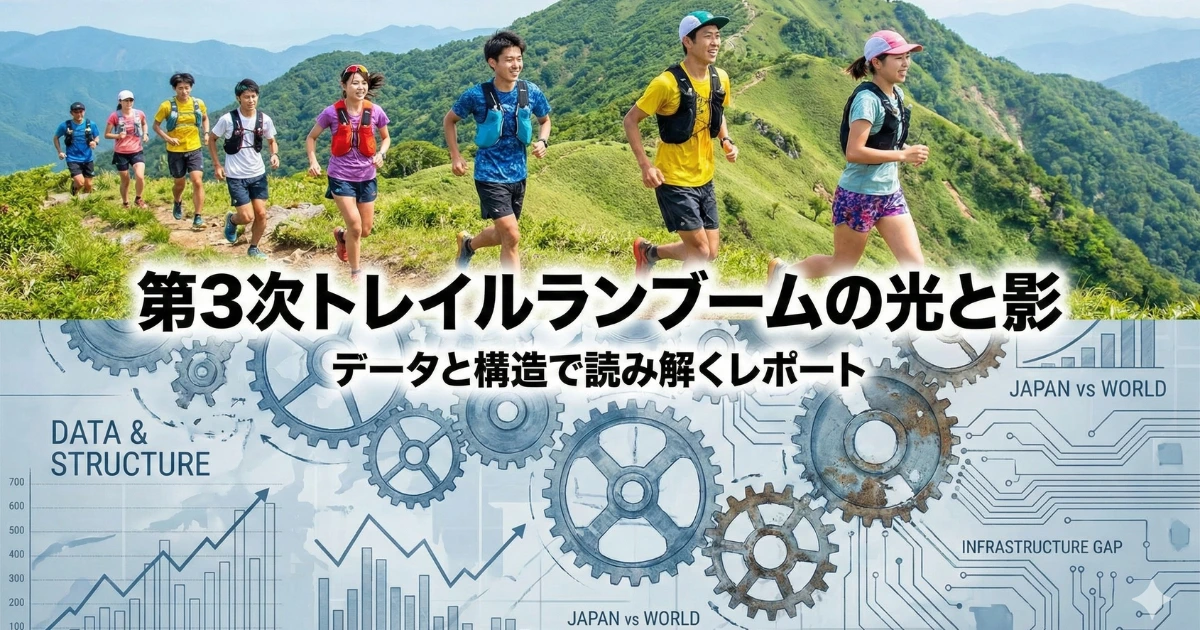
The title: “Japan’s Third Trail Running Boom — Reading the Mountain Running Market in Japan and the World Through Data and Structure.”
The goal was to examine the word “boom” through data rather than impressions or gut feeling. At the same time, the report digs into structural issues that numbers alone can’t explain — why women’s participation rates lag so far behind the global average, why races are bifurcating into megaevents and dying locals, and what exactly is different between Japan and overseas.
The main topics covered:
- A historical comparison of the First, Second, and Third booms
- Entry competition rates for Japan’s major races and global participation data
- Business performance and market trends for major brands like HOKA and Salomon
- Why women’s participation in Japan sits at roughly 20%, compared to the global average of 38% (structural analysis using official survey data)
- The bifurcation of race events: the reality of grassroots races being discontinued and suspended
- An international comparison of “capital structures in race management” across the UTMB Group, China, and Japan
Particular effort went into the analysis of women’s participation rates. The commonly heard explanations — “no time,” “too busy with childcare” — may actually be limited in their explanatory power, as some survey data suggests. According to a Japan-Australia comparative study by the Sasakawa Sports Foundation and Sendai University, the single strongest determinant of sports continuation is a cultural environment — specifically, whether the people around you encourage you to keep going. This is a structural issue, not an individual one.
The Background of Writing This Report
I’ve been running trails for a long time. I’ve raced. I’ve also volunteered and helped support events from the inside.
What I’ve come to feel through that experience is the imbalance between the passion within this sport’s community and the fragility of the infrastructure supporting it. The enthusiasm among runners is genuine. But the systems for sustaining races, the entry points for women and young people, the statistics needed to understand just how many people are actually participating — all of it lags far behind Europe, the Americas, and China.
Whether or not the “Third Boom” translates into something that actually takes root depends, I believe, on whether these underlying structures change.
Writing the report, researching the overseas landscape revealed things I hadn’t known. The scale of the UTMB Group’s business since its partnership with IRONMAN. What drove a 50-fold increase in trail races in China over just a decade. The reality that Japan “doesn’t fit into any of the three capital models” used elsewhere.
This isn’t criticism — it’s a reading of the current situation. You can’t think about the next move without first understanding where things stand.
Who Should Read This
- People who run trails, or who are thinking about getting into it
- People involved in race organization, or considering getting involved
- People interested in sports business and the outdoor industry
- People thinking about women’s sports participation and gender gaps
- Government and NPO staff involved in local sports and regional development
This isn’t an academic paper for specialists. I tried to write it so that anyone with an interest can read it. Sources are cited throughout; estimates and measured figures are distinguished. When I didn’t know something, I said so.
Download the Report
The full text is available as a PDF download. Seven chapters, approximately 12 pages.
→ Trail Running Third Boom Report (PDF)
In Closing
One thing that struck me after putting this report together was just how little data exists. The last survey to measure Japan’s trail running participation population was conducted in 2014. More than ten years have passed since then, and there are no official figures.
You can call it a boom all you like, but there’s no measuring stick to gauge its size. There’s no basis on which to make investment decisions. There’s no way to convey the seriousness of the problems.
If this report helps bridge that gap — even a little — and gives someone in this community the grounding for their next move, then writing it was worth it.